

Lorem ipsum dolor sit amet, consectetur adipiscing elit

BIRD BANDING

VISITOR INTERACTION
Mist-nets may be observed from the paths, but visitors should not approach nets. When at the banding site, visitors should feel free to approach and closely observe the banding process; staff and volunteers will interpret the banding process to visitors and to field questions.

BIRD
SAFETY
The safety of captured birds is a primary focus. However, birds are generally hardy critters, and are well equipped to handle swings in temperature, precipitation, and many other hazards. Every effort is made to ensure the safety and well-being of captured birds.
.jpg)
Mourning Warbler
(photo credit: Tim Carney, MPA/MES)

BURB Staff and Volunteers remove birds from the mist nets. (Photo Credit: Cal Liddell, MPA/MES)
BIRD BANDING AT MASONVILLE COVE

Welcome to Bird Banding at Masonville Cove! 2026 is the fourth year of the banding operation at Masonville, and our location seems to be one of a kind. Urban bird banding stations are rare, making this a unique opportunity to study bird behavior, distribution, and physiology in urban habitats. Evidence suggests that birds migrate differently through urban areas, and these habitats are important to the feeding and nesting of common species. We hope that this bird banding operation can provide useful information on how birds move through Baltimore City and live at Masonville Cove!
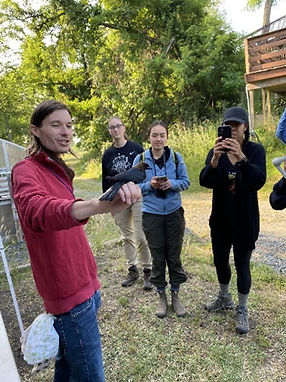

Mike Hudson at the Bird Banding Station and speaking with visitors about birds up close!
Photo credit: Cal Liddell, Matias Orrego (MES/MPA)
WHAT IS BIRD BANDING?
PURPOSE
Bird banding is one of the most important methods of studying wild birds, as it provides information about longevity and other local demographics, migration connectivity, habitat use, and more. When birds are banded, a range of data are gathered, including weight, body condition, breeding condition, plumage aspect, age, and sex. It also provides an opportunity to detect species that are difficult to find or identify under normal field conditions.
PLACEMENT AND MAINTENANCE OF NETS
Mist-nets are installed during the field effort and are so named because the material they are composed of is fine and difficult to see clearly in most natural lighting. Culverts, fence-lines, ditches, treefalls, stream crossings, dead/over-browsed trees, vernal pools, and similar landscape features (natural and man-made) often create vegetation gaps large enough for mist nets. The spaces also tend to frequent passageways from birds moving through a habitat.
BIRD BANDING PARTNERS
Our bird banding is led by Banders-in-Charge from Birds of Urban Baltimore (BUrB). BUrB is an education and outreach organization focused on engaging the local community in bird science and conservation through community events, bird banding demonstrations, internships, and more. Bird banding at Masonville Cove is conducted with the support of Maryland Port Administration (MPA), Maryland Environmental Service (MES), U.S. Fish and Wildlife Service (USFWS), and Living Classrooms Foundation (LCF).
BANDING DATES
You are more than welcome to join us and observe our bird banding migration studies at Masonville Cove!
Bird banding is scheduled to be conducted at Masonville Cove on the following dates:
August: 7, 8, 13, 14, 15, 27, 28, 29
September: 3, 4, 5, 10, 11, 12, 17, 18, 19, 24, 25, 26
October: 1, 2, 3, 8, 9, 10, 15, 16, 17, 22, 23, 24, 29, 30, 31
November: 5, 6, 7, 12, 13, 14, 19, 20, 21
December: 3, 4, 5, 10, 11, 12, 17, 18, 19
Note: This schedule may change due to weather conditions and events could be canceled last minute.
Bird banding staff arrive before sunrise, and visitors are welcome to observe the banding activities when the site opens to the general public at 9:00 AM. Please sign in at the kiosk at the front right side of the Education Center when you arrive onsite. You can also inquire within the Education Center building regarding any additional questions on arrival, or if restroom access is needed. Banding end times vary based on weather, staffing, and number of birds captured, but usually ends before 1:00 PM. Visitors are welcome to explore the trails onsite until 4:00 PM when the site closes.